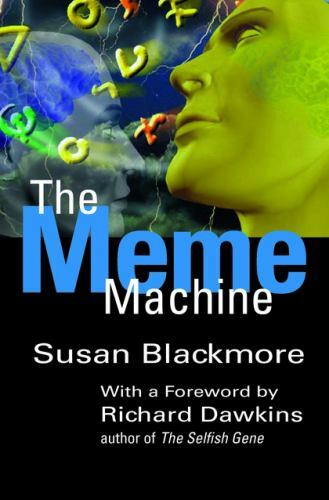
Meme Machine by Susan Blackmore (2000, Uk-Trade Paper)

$ 2.75

Book Series: Popular Science Ser. Intended Audience: Trade Language: English Book Title: Meme Machine Item Height: 0.7 in TitleLeading: The Reviews: "Well-written and personable, this provocative book makes a cognent...case for the concept of memes and for the importance of their effects on human culture."--Publishers Weekly Genre: Social Science, Science, Psychology Item Weight: 10.9 Oz Item Width: 5.1 in Topic: General, Evolutionary Psychology, Anthropology / Cultural & Social, Social Psychology ISBN-10: 019286212X ISBN-13: 9780192862129 Format: Uk-Trade Paper Author: Susan Blackmore Item Length: 7.7 in Dewey Decimal: 304.5 Publisher: Oxford University Press, Incorporated Table Of Content: Foreword by Richard DawkinsPrefaceStrange creaturesUniversal DarwinismThe evolution of cultureTaking the meme's eye viewThree problems with memesThe big brainThe origins of languageMeme-gene co-evolutionThe limits of sociobiologyAn orgasm saved my lifeSex in the modern worldA memetic theory of altruismThe altruism trickMemes of the New AgeReligions as memeplexesInto the InternetThe ultimate memeplexOut of the meme raceReferencesIndex Number of Pages: 288 Pages Publication Year: 2000 Synopsis: What is a meme? First coined by Richard Dawkins in The Selfish Gene , a meme is any idea, behavior, or skill that can be transferred from one person to another by imitation: stories, fashions, inventions, recipes, songs, ways of plowing a field or throwing a baseball or making a sculpture. The meme is also one of the most important--and controversial--concepts to emerge since The Origin of the Species appeared nearly 150 years ago. In The Meme Machine Susan Blackmore boldly asserts: "Just as the design of our bodies can be understood only in terms of natural selection, so the design of our minds can be understood only in terms of memetic selection." Indeed, Blackmore shows that once our distant ancestors acquired the crucial ability to imitate, a second kind of natural selection began, a survival of the fittest amongst competing ideas and behaviors. Ideas and behaviors that proved most adaptive--making tools, for example, or using language--survived and flourished, replicating themselves in as many minds as possible. These memes then passed themselves on from generation to generation by helping to ensure that the genes of those who acquired them also survived and reproduced. Applying this theory to many aspects of human life, Blackmore offers brilliant explanations for why we live in cities, why we talk so much, why we can't stop thinking, why we behave altruistically, how we choose our mates, and much more. With controversial implications for our religious beliefs, our free will, our very sense of "self," The Meme Machine offers a provocative theory everyone will soon be talking about., What is a meme? First coined by Richard Dawkins in The Selfish Gene, a meme is any idea, behavior, or skill that can be transferred from one person to another by imitation: stories, fashions, inventions, recipes, songs, ways of plowing a field or throwing a baseball or making a sculpture. The meme is also one of the most important--and controversial--concepts to emerge since The Origin of the Species appeared nearly 150 years ago. In The Meme Machine Susan Blackmore boldly asserts: "Just as the design of our bodies can be understood only in terms of natural selection, so the design of our minds can be understood only in terms of memetic selection." Indeed, Blackmore shows that once our distant ancestors acquired the crucial ability to imitate, a second kind of natural selection began, a survival of the fittest amongst competing ideas and behaviors. Ideas and behaviors that proved most adaptive--making tools, for example, or using language--survived and flourished, replicating themselves in as many minds as possible. These memes then passed themselves on from generation to generation by helping to ensure that the genes of those who acquired them also survived and reproduced. Applying this theory to many aspects of human life, Blackmore offers brilliant explanations for why we live in cities, why we talk so much, why we can't stop thinking, why we behave altruistically, how we choose our mates, and much more. With controversial implications for our religious beliefs, our free will, our very sense of "self," The Meme Machine offers a provocative theory everyone will soon be talking about., 'Any theory deserves to be given its best shot, and that is what Susan Blackmore has given the theory of the meme I am delighted to recommend her book.' Richard Dawkins Humans are extraordinary creatures, with the unique ability among animals to imitate and so copy from one another ideas, habits, skills, behaviours, inventions, songs, and stories. These are all memes, a term first coined by Richard Dawkins in 1976 in his book The Selfish Gene. Memes, like genes, are replicators, and this enthralling book is an investigation of whether this link between genes and memes can lead to important discoveries about the nature of the inner self. Confronting the deepest questions about our inner selves, with all our emotions, memories, beliefs, and decisions, Susan Blackmore makes a compelling case for the theory that the inner self is merely an illusion created by the memes for the sake of replication. 'Anyone who hopes-or fears- that memetics will become a science of culture will find this surefooted exploration of the prospects a major eye-opener.' Daniel Dennett, Humans are extraordinary creatures, with the unique ability among animals to imitate and so copy from one another ideas, habits, skills, behaviours, inventions, songs, and stories. These are all memes, a term first coined by Richard Dawkins in 1976 in his book The Selfish Gene. Memes, like genes, are replicators, and this enthralling book is an investigation of whether this link between genes and memes can lead to important discoveries about the nature of the inner self. Susan Blackmore makes a compelling case for the theory that the inner self is merely an illusion created by the memes for the sake of replication., Humans are extraordinary creatures, with the unique ability among animals to imitate and so copy from one another ideas, habits, skills, behaviours, inventions, songs, and stories. These are all memes, a term first coined by Richard Dawkins in 1976 in his book The Selfish Gene. Memes, like genes, are replicators, and this enthralling book is an investigation of whether this link between genes and memes can lead to important discoveries about the nature of the inner self. Confronting the deepest questions about our inner selves, with all our emotions, memories, beliefs, and decisions, Susan Blackmore makes a compelling case for the theory that the inner self is merely an illusion created by the memes for the sake of replication. brand: Oxford University Press, Incorporated gtin13: 9780192862129 Dewey Edition: 21